History
Curriculum Intent
We provide our students with a diverse and rich curriculum. They look at local, British and world history and develop an understanding of the different people, cultures and the events that have shaped our lives.
Knowledge
All people are living histories, so understanding the linkages between past and present is absolutely fundamental for a good understanding of the human condition. It is not just “useful”, it is essential. Learning history is more than just facts and dates for our pupils, but the feeling of the past; the myth, the magic and the mysteries that we ourselves can attempt to unfold.
Purpose
To quote William Faulkner, “the past is not past”; the stories, ideas and values of historical events and people determine the world we live in. Studying history allows our pupils to develop a better understanding of the world around them whilst cultivating a sense of identity linked to their local and national community. Moreover, in a world where it is increasingly difficult to sift opinion from fact, the skills developed in history can provide our students with objectivity and tolerance to view the world with through critical, but empathetic, eyes.
Proactivity
Curiosity – Historical thought involves highly critical thinking skills and a curiosity displayed by asking questions of the past (the who, why, what, when and how). We also encourage our pupils to show curiosity through engaging with family, local, national and international histories.
Commitment – We want our pupils to develop their skills of being a historian and show perseverance in strengthening their abilities to analyse sources, evaluate historical interpretations and weigh up evidence to form judgements on the past.
Courage – Pupils will feel empowered to not only form well-reasoned opinions, but share these and debate them with their peers. Our pupils should also develop resilience and confidence in tackling challenging extended writing tasks to demonstrate these historical judgements.
Curriculum Map
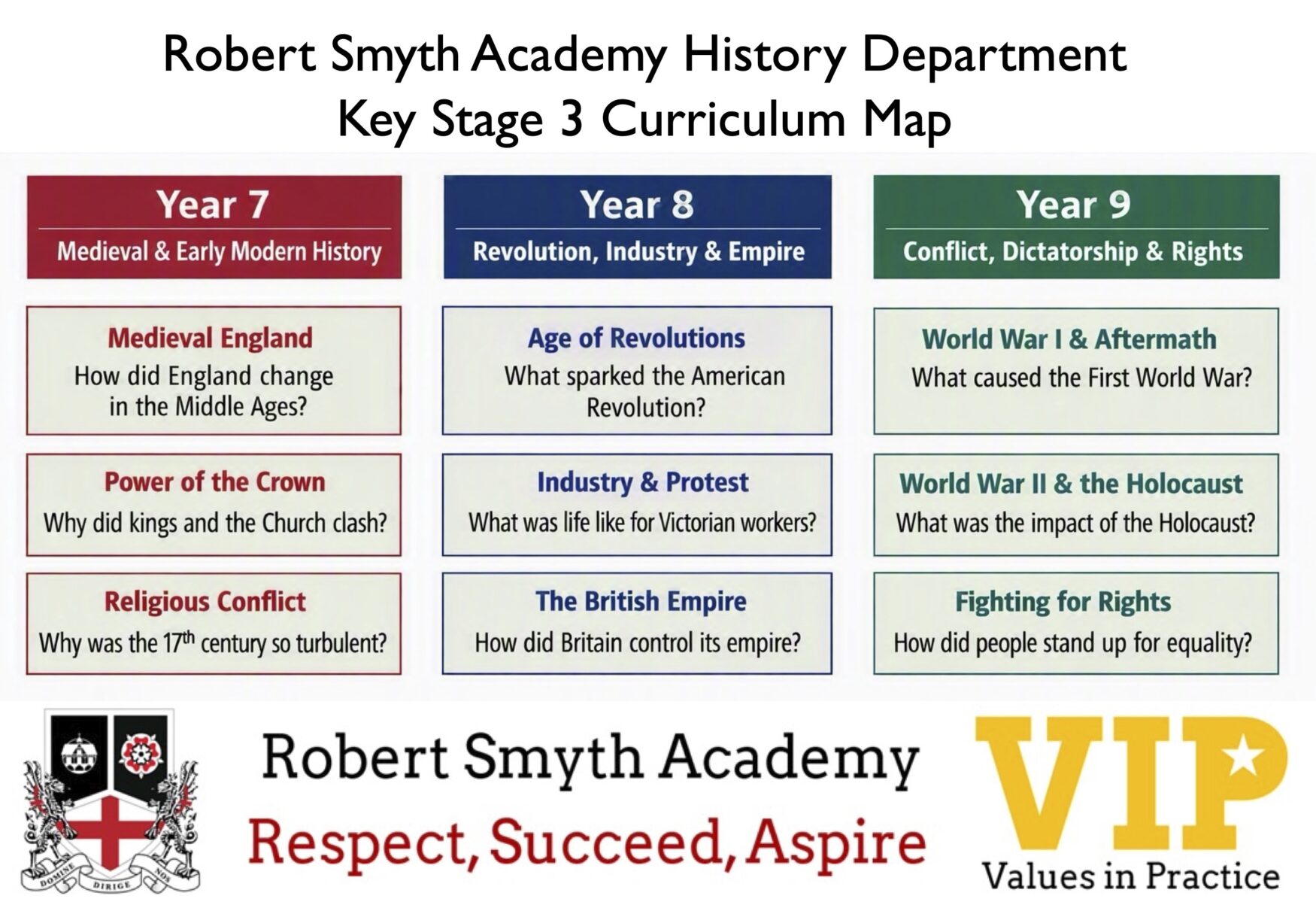
The Curriculum Map below contains a small selection of the sort of questions that pupils will encounter in their studies.
Year 10 GCSE Expertise
Students will study National and International History from 1250 until today, understanding the narrative of events and analysing them, focusing on five great schools of History: Political, Socio-Economic, Ideological and Personalities (‘The Great Man of History’ school).
Students will study:
Half term 1: Mediaeval and Renaissance Medicine (causes, preventions, treatments)
Half term 2: Industrial Medicine in the Victorian Age
Half term 3: Modern Medicine (including case studies and review of the Unit)
Half term 4: Medicine in one specific Environment (Medicine on the Western Front in World War 1)
Half Term 5: Elizabethan England, government, Religion and challenges at home and abroad
Half Term 6: Elizabethan Society in the Golden Age of Exploration
Year 11 GCSE Expertise
Students will then study Germany 1918-1939 in the following two half terms:
Half Term 1: Weimar Germany, the growth of democracy and the Rise of Hitler
Half Term 2: Nazi consolidation of power and Life in Nazi Germany
Students then complete their studies with an examination of the Cold war from 1941-91 (though with an obvious relevance to contemporary events)
Half Term 3: The Origins of the Cold War
Half Term 4: The Development of the Cold War – Escalation of tensions, leading to Détente and collapse of the then Soviet Union.
Student will finish their studies by Easter with an Overview of the Cold War.
This allows the final half term of year 11 to be dedicated to in depth revision of the above topics.
Edexcel GCSE Course
The GCSE history course aims to provide students with a broad knowledge of history. Students will cover Medieval to Modern History, and consider countries such as Britain, America, the USSR, and Germany.
It is important to remember that History is not just about facts and dates. It is about understanding why humans behaved the way they did in the past. Studying History will develop your ability to think clearly and logically, research, analyse, hypothesis, argue and criticise. There is also a focus on developing writing skills, which complements many other subjects in the curriculum.
Assessment: The GCSE is assessed by three exam papers, sat at the end of Year 11. All students sit the same exam papers: Paper 1 (Medicine), Paper 2 (Elizabeth and Cold war), paper 3 (Weimar and Nazi Germany).